The order schools teach them

The national curriculum in England builds the tables up over three years. Practise the ones your child is learning now, not the whole lot at once.
- Year 2 (ages 6 to 7): the 2, 5 and 10 times tables.
- Year 3 (ages 7 to 8): the 3, 4 and 8 times tables.
- Year 4 (ages 8 to 9): the 6, 7, 9, 11 and 12 times tables, so every table up to 12 x 12.
Every table has its own pattern, and spotting it is half the work. That is what the games below are built on.
Before the tables: counting in steps (ages 5 to 6)
- Stair counting. Count in 2s on the way upstairs, one step per number. Count in 10s on the way down.
- Socks and hands. Pair the socks from the wash and count them in 2s. Count fingers in 5s, a hand at a time.
- Coin towers. Make towers of 2p, 5p and 10p coins and count how much is in each tower.
The 2s, 5s and 10s (Year 2)
- Clap instead. Count from 1 to 30 together, but clap instead of saying every number in the 5 times table. Then try the 2s.
- The clock face. Every number on a clock is a step of 5 minutes: the 3 means 15, the 9 means 45. Point at a number, they call out the minutes.
- Odds and evens. Every answer in the 2 times table is even. Read out numbers; they jump for even and crouch for odd.
- Toy groups. Line up toys in groups of 5 or 10. Three groups of ten: how many toys? Then let them set you one.
The 3s, 4s and 8s (Year 3)
- Double, double, double. The 4s are the 2s doubled, and the 8s are the 4s doubled. Roll a dice, double it, double again, double again: three answers in one go.
- Fizz. Count round the table taking turns, and say "fizz" instead of any number in the 3 times table. Whoever slips starts again.
- Digit check for the 3s. Add the digits of any answer in the 3s and you get 3, 6 or 9: 27 is 2 + 7 = 9. Children love having a way to check.
- Dice grid. Draw a 3 by 3 grid of answers from the 3s and 4s. Roll a dice, multiply by 3 or 4, and cross off the answer if it is there.
The 6s, 7s, 9s, 11s and 12s (Year 4)
- The 9s finger trick. Hold up ten fingers. For 9 x 4, fold down the fourth finger: 3 fingers to the left, 6 to the right, so 36.
- The 6s from the 3s. Every 6 is a 3 doubled: 3 x 7 is 21, so 6 x 7 is 42.
- The 11s pattern. Up to 9 x 11, the digit is just written twice: 11, 22, 33. Then 10 x 11 is 110, 11 x 11 is 121 and 12 x 11 is 132.
- The 12s as 10 and 2. 12 x 7 is 10 x 7 (70) plus 2 x 7 (14), so 84.
- Find the hard few. Once the patterns are in, only a handful are left that many children find hard, often 6 x 8, 7 x 8 and 7 x 7. Write those on the fridge and leave the rest.

Bright Eyed Kid
A storybook where they star on every page
Written from scratch around your child, with the people and things they love.
Games with a pack of cards
- Times tables snap. Take out the picture cards. Turn over two cards; the first to shout the two numbers multiplied wins the pair.
- Times tables war. Each player turns over two cards and multiplies them. Biggest answer takes all four cards.
- One table only. Choose this week's table, say the 7s. Turn over one card at a time and multiply it by 7. Time ten cards, then try to beat it tomorrow.
- Pairs. Write ten sums and their ten answers on scraps of card, lay them face down and play pairs.
Games with nothing at all
- Ping pong. You say "6 x 4", they bat back "24" and a sum of their own for you. Keep the rally going.
- Number plates. Multiply the first two numbers on the car in front.
- Answer first. You give the answer, 56, and they find the sum: 7 x 8. Harder than it sounds, and good for the hard few.
- Times tables hopscotch. Chalk the answers in a hopscotch grid and hop along a table out loud.
Getting ready for the Year 4 check
In June of Year 4, children in England take the Multiplication Tables Check: 25 questions on a screen, with six seconds to answer each. It is a quick check, not a test to pass or fail.
- Speed comes last. Children get quick by knowing the facts, not by being timed early on. Play first, time later.
- A minute a day. From the spring of Year 4, one minute of quick-fire ping pong at breakfast is plenty.
- Keep it light. Your child's school will tell you how they practise. If your child is worried, have a word with their teacher.
Five minutes, most days
- Monday: say the week's table out loud together, looking for the pattern.
- Tuesday: a card game.
- Wednesday: ping pong in the car or on the walk to school.
- Thursday: answer first, with the hard few.
- Friday: they test you, and you make a mistake on purpose.
A sticker for each day fits neatly on a simple chart; see reward charts for kids.
A story for when the cards go away
Practice goes better when the rest of the evening is something to look forward to. A Bright Eyed Kid book is a new story written around your child, where they star on every page, so it is one they will ask for again.
- About them. You answer three short questions about your child and can add a story idea of your own, so a child who loves numbers, puzzles or codes can have a story where that matters.
- Family alongside. Up to five co-stars, each with a photo and a name.
- Drawn so they recognise themselves, in one of four picture styles: Playful, Standard, Quirky or Classic.
- Right for their age. The writing changes for every age from 3 to 10.
- You check it first. Read a free story outline before you pay, then change any words or pictures until it feels right.
More short games in spelling games for kids, riddles for kids and rainy day activities.
What it costs

A digital book is £8.49 and a printed hardback is £29.99, plus £2.95 delivery. Every book is 32 pages.
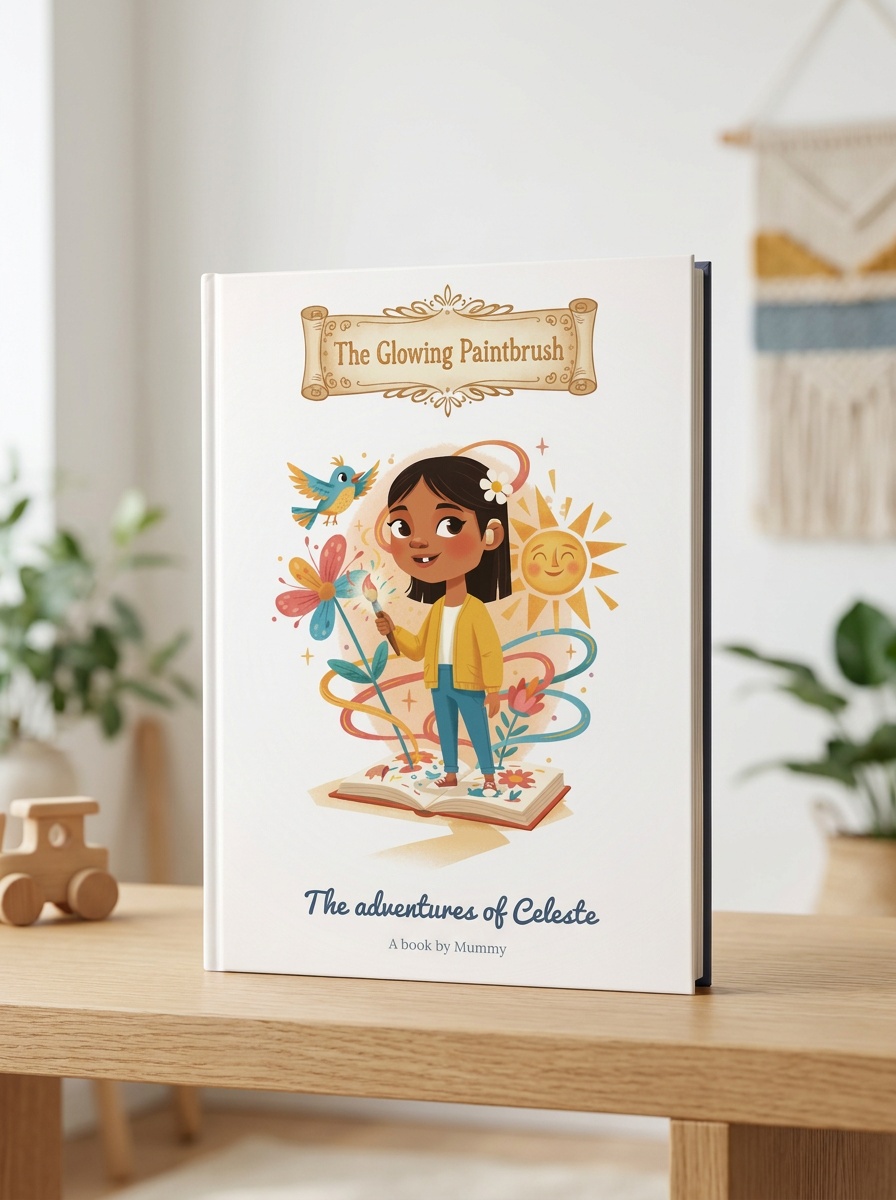
Make a book they will ask for every night
- A new story, written from scratch around them
- Their family, pets and favourite things inside
- Read a free story outline before you pay
- Change any words or pictures until it feels right
32 pages · digital £8.49 · hardback £29.99
An example book. Every title, cover and story is made for one child.
Questions parents ask
What order should children learn their times tables?
Schools in England teach the 2, 5 and 10 times tables in Year 2, the 3, 4 and 8 in Year 3, and the 6, 7, 9, 11 and 12 in Year 4, so every table up to 12 x 12 by the end of Year 4.
What are good times tables games to play at home?
Card games such as times tables snap and war, fizz for the 3s, ping pong where you bat sums back and forth, the 9s finger trick, and multiplying the numbers on number plates.
What is the Year 4 Multiplication Tables Check?
In June of Year 4, children in England answer 25 times tables questions on a screen, with six seconds for each. It is a quick check rather than a test to pass or fail.
Which times tables are hardest?
Once children know the patterns, many find only a few hard, often 6 x 8, 7 x 8 and 7 x 7. Practise those on their own rather than the whole table.
How long should we practise times tables each day?
About five minutes, most days. Short games out loud work better than long sessions, and speed comes once the facts are known.